
You might have seen the headlines about the Government’s new Your First Home scheme – a 2.5% deposit, a 20% Government equity loan and a smaller mortgage.
On the face of it, it sounds pretty good. But before anyone gets too excited, it’s worth saying that the scheme hasn’t actually been fully confirmed yet.
We still don’t know the final eligibility rules, income limits, property price caps, how long the equity loan will be interest-free or exactly how it will need to be repaid.
So, for now, we’re looking at what’s been proposed rather than a finished scheme.
If you’re thinking this sounds a bit like the old Help to Buy Equity Loan, you’d be right.
The basic idea is very similar – you put in a deposit, the Government provides an equity loan and you take a mortgage for the rest.
The main difference being talked about is the deposit.
Help to Buy generally needed at least 5%. Your First Home is proposing just 2.5% but we don’t yet know whether the equity loan itself will work exactly the same way.
The important bit here is that the Government isn’t giving you 20% of the house for free. It’s a LOAN.
Under the old Help to Buy scheme, if you had a 20% equity loan and the house went up in value, the amount needed to repay the loan went up too.
We don’t yet know whether Your First Home will work in exactly the same way.
We’re still waiting to find out:
- How long it will be interest-free
- What charges apply afterwards
- How repayment will work
- What happens when you sell or remortgage
Those details are pretty important before deciding whether the scheme is actually good value.
We don’t know all of that yet either.
What has been proposed is:
- First-time buyers (from select developers – to be confimed which developers)
- New-build properties
- Household income limits
- Local property price caps
The actual limits haven’t been confirmed yet and you’ll still need to pass a lender’s normal affordability and credit checks for the mortgage itself.
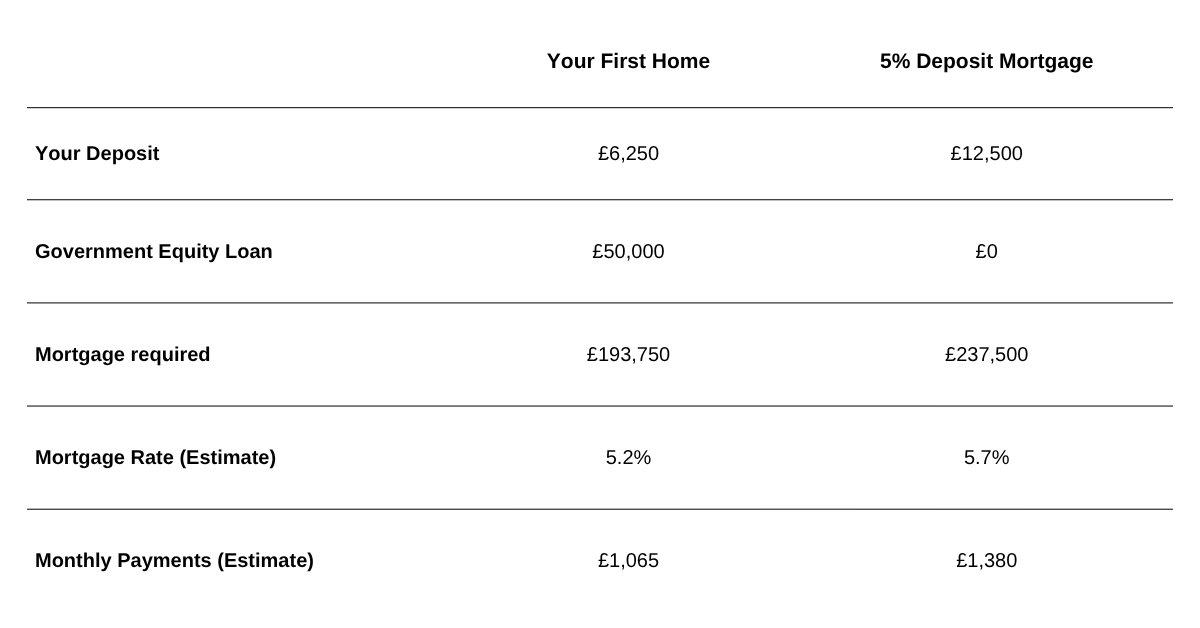
Let’s take a £250,000 property.
That’s where the scheme starts to look attractive.
You need £6,250 less upfront, your mortgage is £43,750 smaller and, using the example above, the monthly mortgage payment is around £315 lower… that’s nearly £3,800 a year.
But you haven’t saved £50,000 – you’ve borrowed it in a different way.
You’d still have the Government equity loan to deal with at some point, and until we know exactly how that works, we can’t properly compare the overall cost.
One part of the scheme we do think could be really useful is the lower loan-to-value (LTV). This is the size of the mortgage compared to the value of the property – think bigger deposit, lower LTV.
Generally, the lower the loan to value, the lower the risk to the lender.
That can mean:
- Better mortgage rates
- Potentially more lenders available
- Credit scoring can sometimes be easier to pass
That last one could make a real difference for some buyers. Someone who struggles to pass a lender’s credit score at 95% loan to value may pass the credit score at a lower loan to value.
It’s not guaranteed – lenders will still look at your credit history, affordability and everything else – but a lower loan to value could be the difference between being able to buy your first home and not.
There are already options for buyers with very small deposits.
0% deposit mortgages
Some lenders have come out with products which allow eligible buyers with no traditional deposit at all.
They won’t suit everyone and the criteria can be quite strict, but they’re already an option for some first-time buyers.
£5,000 deposit mortgages
There are also mortgages where eligible buyers can purchase with a fixed £5,000 deposit. Again, stricter rules do apply due to added risk but the possibility is there.
There are also things like Joint Borrower Sole Proprietor mortgages, family-assisted mortgages, Shared Ownership and other first-time buyer products. So this new scheme won’t automatically be the best option just because the deposit is smaller.
What if my property goes up in value?
So if a 20% equity loan started at £50,000 and the property later increased in value, the amount needed to repay it could be higher.
But you’d still benefit from your share of that increase too.
If it followed the Help to Buy model, you’d effectively keep 80% of any increase in value, while also building further equity by paying down your mortgage each month.
We’ve helped plenty of clients over the years remortgage and repay their Help to Buy equity loans once they’ve built enough equity and their circumstances have improved.
We don’t yet know whether Your First Home will work in exactly the same way, but if it does, this is something brokers are already very familiar with.
Aren't you just borrowing the deposit another way?
To an extent, yes.
The 20% Government contribution hasn’t disappeared – you’ve just borrowed that part differently.
The potential benefit is that you’re taking a much smaller conventional mortgage from day one. That means lower monthly mortgage payments, a lower LTV and potentially better mortgage rates.
A few years down the line, your mortgage balance should also be lower and your income may have increased, which could make raising funds to repay the equity loan easier.
That’s why we wouldn’t just look at the equity loan on its own.
What about the new-build premium?
This is definitely something buyers should think about.
New-builds do tend to sell at a bit of a premium and, in the short term, they can lose some of that once the new-carpet smell has worn off and they’re no longer brand new.
That doesn’t automatically make them bad value though. If you’re planning on staying there for the medium to long term, the property has more time to move with the wider market, while you’re also paying down your mortgage and building equity along the way.
The important bit is making sure you’re happy with the property and the price you’re paying for it in the first place, rather than buying it just because there’s a Government scheme attached.
Could the scheme push house prices up?
It’s possible that increasing demand could put some upward pressure on prices.
Help to Buy has often been criticised for contributing to house-price growth, although it’s difficult to separate the scheme from everything else happening in the housing market at the time.
Mortgage rates were much lower for large parts of the previous scheme and there was strong demand from home movers as well as first-time buyers.
Your First Home is also expected to be restricted to new-build properties, with one of the aims (I imagine) being to encourage developers to build more homes.
If it genuinely increases housing supply, that could help offset some of the extra demand.
Ultimately, we’ll only know the real impact once the scheme has been running for a while.
Does it actually help with affordability?
Yes.
Using our £250,000 example, instead of needing a £237,500 mortgage, you’d only need to borrow £193,750.
As mentioned earlier in this blog, the lower LTV can also mean access to better mortgage rates, so you could benefit from both borrowing less and paying a lower rate on the mortgage you do need.
That can make affordability easier, open up more lender options and leave more money in your pocket each month too.
You still need to be comfortable with the payment and make sure the overall deal works for you, but there’s no getting away from the fact that a smaller mortgage at a potentially better rate can make a big difference.
What happens when I want to remortgage or move?
We don’t know the exact rules yet.
If the scheme works in a similar way to Help to Buy, this shouldn’t necessarily be a major problem.
We’ve helped Help to Buy clients remortgage, raise additional funds and repay their equity loan for years.
There can be a few extra hoops to jump through – valuations, legal work and administration – but it’s certainly not unusual territory for a mortgage broker.
Until the final rules are confirmed, though, we can’t assume Your First Home will work exactly the same way.
What about the income and property price caps?
We know the Government intends to introduce household income limits and local property price caps, but we don’t yet know what those figures will be.
They’ll need to be set carefully.
Too low and the scheme could exclude people who are still struggling to buy in expensive areas.
Too high and there’s an argument that Government support could end up going to people who may have been able to buy anyway.
We’ll know a lot more once the actual limits are published.
On the face of it, there’s a lot to like about Your First Home – a smaller deposit, lower mortgage borrowing and potentially better rates because of the lower loan to value.
But there are still some important details missing, particularly around the equity loan and who will actually qualify.
So, for now, let’s see what gets announced at the Budget on 28 October.
More options, better outcomes.
If you’re thinking about buying your first home and want help understanding your options, get in touch and we’ll talk you through them.